
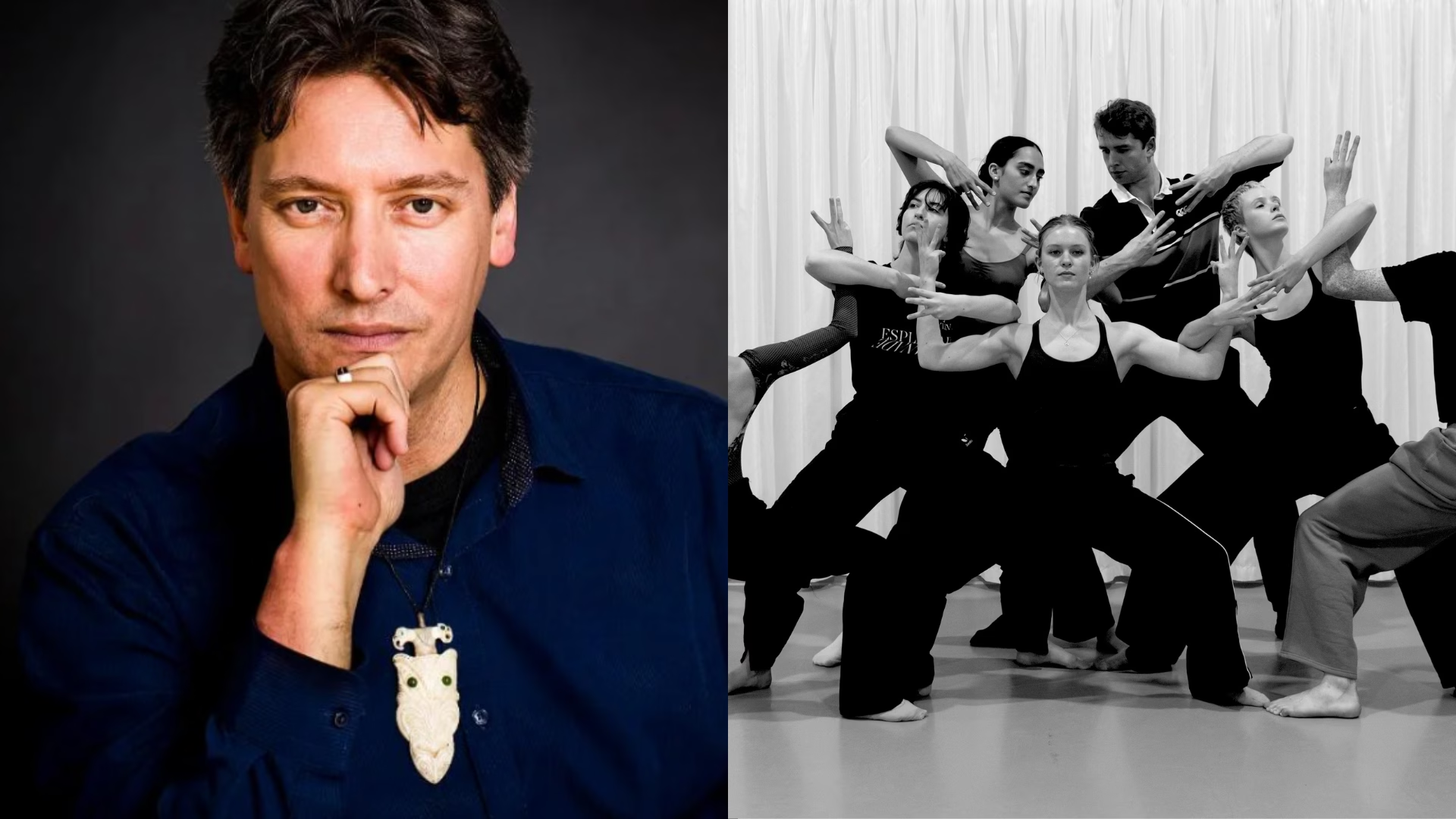
Two Creation Stories: Tānemahuta Gray on choreographing for CREATION
Featuring Ballet Collective Aotearoa with choreography by Tānemahuta Gray, Orchestra Wellington’s performance of La Creatión du Monde conveys not one, but two powerful creation stories.
Te Ao Māori’s creation story of the separation of Ranginui and Papatūānuku, and the creation of Hine-Ahu-One and Hine Titama by Tāne Mahuta may be widely known across Aotearoa, but on 22 August at 7:30pm in the heart of Wellington, Orchestra Wellington and Ballet Collective Aotearoa will join forces to tell this story in a whole new way.
Prior to composing La Création du Monde, Darius Milhaud encountered jazz in London in 1920, but his experience of Black American jazz in Harlem during his 1922 visit to New York had a particularly profound impact on him. He became fascinated by its rhythms, instrumental colours and freedom. He then essentially took those sounds home and incorporated them into a European classical composition. He wrote La Création du Monde, Op. 81a, in 1922–23 as a ballet for the Ballets Suédois in Paris. It premiered at the Théâtre des Champs-Élysées on 25 October 1923. The story describes the creation of the world, drawing on African mythology as it was represented in Cendrars’s Anthologie nègre. It moves from primordial chaos through the emergence of plant and animal life, then humanity, desire and finally a kind of spring-like resolution.
Set against a performance of Milhaud’s work depicting this African creation story, dancers of Ballet Collective Aotearoa will take the stage to perform powerful Māori creation story, bringing Te Ao Mārama to life on stage through exciting new choreography by Tānemahuta Gray.
Read our Q&A with Tānemahuta below to learn more about him, his creative process, and the story behind his choreography for CREATION.
Tell us a bit about yourself…
Q: For those who may not know you or your work, could you tell us a little about yourself, your training as a choreographer and artist, and the journey that has brought you to where you are today?
A: I am a Wellington born and bred choreographer and live performance artist, who graduated from the New Zealand School of Dance in 1994. My work usually has focused on aerial, kapa haka, and contemporary dance choreography, having created large scale shows called “Māui – One Man Against The Gods” (2003-2007), “Tiki Taane Mahuta” (2015 – 2017) and Hatupatu | Kurungaituku – A Forbidden Love which opened the Aotearoa New Zealand Festival of the Arts in 2024.
I have been a guest choreographer of the South Pacific and Aotearoa sections for WOW – World of WearableArts Awards since 2009.
Other choreographic highlights were choreographing the Shanghai World Trade Expo Oceania work at their large scale opening ceremony in Shanghai in 2010 (sharing a stage with Andrea Bocelli, Tan Dun, Quincey Jones, Lang Lang and Jackie Chan as MC) , and choreographing the Workshop Lab for the Broadway Musical “Otherworld” in New York in 2018.
Q: What drew you to choreography, and how has your artistic practice developed over time?
A: Funnily this is a return to my Classical Ballet training that was my entry point into dance as a 6 year old. I haven’t choreographed a classical work for 28 years, so it is a real treat to come back into this blended classical ballet and contemporary dance forms.
I was drawn to choreography, when I was recovering from a knee injury, and had to find another way to express my creative spirit. The addition of adding aerial based choreography (harness aerials) from the 5 years I worked as an aerial performer at De La Guarda in London, Las Vegas, Buenos Aires, Berlin and Amsterdam was a big revolution in finding ways to tell te ao Māori stories in three dimensional ways. I have been a performer on the Te Matatini stage in the 1990’s also.
Q: What role does your identity and connection to te ao Māori play in the way you create and tell stories through movement?
A: My connection to my Ngāi Tahu, Rangitāne and Waikato roots (adopted), has been a massive contributor to my work. I love the epic scale of our historical narratives, and working on Creation Du Monde, and bringing our own Te Ao Māori Creative Stories of the separation of Rangi and Papa, and the creation of Hine-Ahu-One and Hine Titama by Tāne Mahuta has been a good challenge to bring this story alive through a composition of Milhaud from 1923.
The Ballet Collective Aotearoa and Orchestra Wellington collaboration…
Q: This performance brings Ballet Collective Aotearoa and Orchestra Wellington together onstage [for the second time]. Can you tell us about the relationship between BCA and Orchestra Wellington, and what excites you about collaborating across dance and orchestral music?
A: BCA and OW have worked together previously, (Turid can pass on those dates), but this is my first time working for both companies. It is a real privilege to get the opportunity to create a neo-classical work, and when Turid Revfeim asked me to choreograph this work I jumped at the opportunity.
This is also my chance to work with a live orchestra for the first time, so it will be a new and exciting evolution of my choreographic practice to have this opportunity. We will have limited opportunities to rehearse with the orchestra, and the staging of the work means we will have limited time on stage (only on the day), to make it all work on the staging available to us. But live performance is always exciting knowing you have to be prepared by lights up and the arrival of the audience.
Q: What do you think dance and live orchestral music can bring to each other that neither art form can quite achieve on its own in this context? Are there inherent difficulties in collaborating in this environment?
A: I think the emotional potency of a work is significantly increased with live orchestra instead of playback. Just listening to an orchestra on their own is an empowering experience. So dancing with them playing behind you will be incredible. The difficulties is the limited time you have, to get a feel of how the timings of the orchestra and conductors pacing of the work will be, compared to the playback of the piece that we use at rehearsals. Marc Taddei provided us with the version (Leonard Bernstein’s) that he is likely to be comparable to his pacing of the orchestra. And versions can change by 30 seconds to a minute in a 17 minute work. So it can be quite different speeds for certain sections to have to adapt too.
Q: What does it mean to you to be creating this work with Wellington orchestra and presenting it to a Wellington audience?
A: Providing our own creation myth, and Aotearoa perspective to Milhaud’s work is a unique proposition for this work to be experienced by Wellington audiences. Also, the opportunity when you get two Wellington based arts companies (OW & BCA) and myself as a born and bred Wellingtonian who has lived most of my life here, we can really show the talent that comes out of this amazing city.
Two Creation Stories and the conception of your choreography
Q: Milhaud’s work draws on African American musical influences and tells its own creation story, while your choreography draws on the creation of Te Ao Mārama and the separation of Ranginui and Papatūānuku. What connections or synergies did you discover between these two cultural narratives?
A: It was super tricky at first to find a link to Milhaud’s music composition, which I felt was a Euro-Centric perspective on an African Creation historical narrative, so it had a problematic process in its initial creation. (They used very big costumes in the first outing, that did look challenging to move in as the reviews expressed). So at first I wondered if I could crack a code to find relevancy in our creation myth stories to this type of composition which is not Māori at all. I then moved the story so it started right in the separation of Ranginui and Papatūānuku by Tāne Mahuta, and then retrograded back out to the commencement of the relationship between Rangi and Papa. Then I told the full story of their love and the birth of Tāne, and then the music leaned into sharing the second and third stages of creation with the creation of Hine-Ahu-One and then their daughter Hine Titama. These stories worked really well with the music, so it felt right to add their telling into the narrative. It meant we could tell a strong female deity story alongside the strong male deity story. But I have really leaned into the duality of our atua, (Māori deities), as they are more elemental in their form. So it provides some creative casting opportunities to be creative within.
Q: The story of Tāne-Mahuta creating space between his parents and bringing the world from darkness into light is such a powerful story of transformation. What aspects of that story were particularly important to you as you began developing the choreography?
A: The desire and yearning for expressing one’s own independence, and having the opportunity to provide your creations on the world is the key theme within the separation of Rangi and Papa. I wanted to honour these primordial parents and atua, but also it provided the opportunity to also bring in the human personalities to these characters, and hopefully make them more emotionally resonant to the audience watching the show.
Q: How do you approach telling a story from te ao Māori through contemporary movement in a way that honours the story while also allowing the choreography to speak in its own artistic language?
A: The music is a big guide for me. I hear what the music is telling me, and build the choreographic form with that inspiration. The audience will definitely experience both ballet and contemporary forms, that Milhaud has provided us with his use of jazz and strings and percussion and brass within his composition.
Q: When you first began conceptualising this work, where did you start? Was it with the creation story, the music, the characters, the dancers, or something else?
A: I started with the narrative story I wanted to tell. And found a way to build the libretto to the already existing music. That required its own creative process, but once I got the libretto into the narrative beats of the music, we could start to build those scenes within the work.
Secondly, as we had more female dancers than male dancers, I leaned away from Tāne and his brothers story, and leaned into the second and third creation phases of the world with Hine-Ahu-One and Hine Titama being key characters in the retelling of the narrative.
Q: Are there particular rhythms, textures or moments in La Création du Monde that immediately suggested movement to you?
A: Yes, there are moments when it cries out for a purely ballet allegro (jumping section) within the surge of the music, and other sections which are much more intimate, so I have gone with a more introspective quality to how we have staged those scenes. But the narrative is always dominant for me, so each choreographic convention used has to help with the story telling.
Q: Tāne-mahuta’s separation of Ranginui and Papatūānuku is a necessary act of courage to bring forth Te Ao Mārama – something has to be torn apart in order for something new to emerge. This includes, of course, the journey from darkness and confinement towards light, space and the creation of life. How does that journey manifest itself in the physical language of the dancers?
A: We have tried to bring a humanist manipulation into the separation of Rangi and Papa into the choreography, so one can feel the tension of what it would be like to be torn apart by your offspring. This then moves to the use of space and long extensions when Tāne Mahuta finally has the room to move and express themselves within Te Ao Mārama. Hopefully the audience will be able to read this change in the choreography and staging of the work.
Your collaboration with BCA and anticipations about the BCA/OW performance
Q: What has the process of working with the dancers been like? Have they contributed to the development of the movement language or the way the story is told?
A: Yes the dancers have helped me build each choreographic section in the rehearsal room, and it is always a joy to get offers from the dancers in the studio. Thus far we have had a good flow in rehearsals. Also the flexibility of the Wellington based dancers who have been able to attend more rehearsals prior to the arrival of the Auckland based dancers has been awesome, as we have had to create some scenes with the understudy dancers do the creation of the role.
Q: How does choreographing for live orchestral performance differ from creating a standalone dance work?
A: I will let you know after I finish my first performance with a live orchestra. Looking forward to the challenge.
Q: Is there a particular moment in the performance that you find yourself returning to, or that you hope audiences will carry with them after the performance?
A: I hope that people feel an affinity to the aspiration and the tragedy to all the characters into this narrative. They all gain something, and they also all lose something in their aspirations throughout their own narrative arc. I would love to get feedback from the audience as to whom they felt connected to and why.
Q: Creation stories are, in many ways, stories about who we are and how we understand our relationship to the world around us. What do you hope audiences might take away from encountering this story through dance?
A: Firstly, that our te ao Māori creation narratives can be expressed in different choreographic forms and provide a new lens too the work. In my work Māui – One Man Against The Gods, the opening 10 minute prelude was the Te Ao Mārama separation, with sheets over the performers on stage whose movement was more kapa haka form, and circus aerialists on Web and other aerialists flying over the audiences heads in the St James Theatre. This will be a completely different take (and more humanistic and personal in its presentation), rather than the Cirque Du Soleil-esque nature that I told the story through Māui. It’s more of a choreographic challenge for me, but I am loving the challenge.
Q: What does Te Ao Mārama—the world of light—mean to you in the context of this work?
A: The awakening of potential, possibility and new life! Transformation of the world, whilst the mind also gets opened up in this unique offering of a common narrative.
Q: Finally, if you could give audiences one thing to listen for, look for or think about when they experience CREATION, what would it be?
A: The piece doesn’t start where you think it might commence. I hope the audiences are ready for a nice surprise to your usual Orchestra experience!!! (Got to be there to experience it).
Mauri tū, mauri ora.
Tānemahuta Gray
Work with us!
We are an equal opportunity employer.
Everyone is welcome at Orchestra Wellington!
We feel strongly that the diverse backgrounds, lived experiences, and individual contributions of our employees are an integral part of what makes the arts relevant, accessible, meaningful, impactful, and sustainable.
Reach out to find out about our current vacancies.